
Your Board Meetings Need More Than Good Intentions

A lot of startup nonprofit leaders hold their first board meeting with the best of intentions. Everyone's excited. Everyone cares about the mission. Someone takes notes in a spiral notebook. And then six months later, when it's time to open a bank account or demonstrate compliance to a funder, the wheels start to come off.
Board meetings are not just gatherings. They are legal documentation. And if you're not running them with that in mind from the very beginning, it will cost you.
Structure First
Your board meetings don't have to follow Robert's Rules of Order to the letter. But they do need a predictable, repeatable flow — the same structure every time — so your board can make sure everything gets handled in the time allotted. When meetings are improvised, things get missed. And in a nonprofit, missed things have consequences.
Here's what that structure typically looks like:
Call to order: Someone — usually the board chair — officially opens the meeting. This sounds formal, but it matters. It signals that what happens next is on the record.
Quorum check: Before any business can be conducted, you need to confirm that enough voting members are present to make decisions legally. What counts as a quorum should be spelled out in your bylaws.
Approval of the agenda: The board formally agrees on what will be covered. This keeps meetings focused and creates a record of what was intended to be discussed.
Approval of prior meeting minutes: The board reviews and approves the minutes from the last meeting. This is how your documentation becomes the official record — it's not official until the board says it is.
Reports: This is where your executive director, treasurer, and any committee chairs give updates. Financials should be reviewed at every meeting, not just quarterly. If something is off, the board needs to know.
Old business: Anything that was tabled or unresolved from a previous meeting gets addressed here.
New business: This is where new topics, decisions, and votes happen. If a motion is made, it needs to be seconded, discussed, voted on, and recorded — every time.
Announcements: Upcoming events, deadlines, or anything the board needs to have on their radar.
Adjournment: The meeting is officially closed. That gets recorded too.
This doesn't have to take hours. A well-run board meeting for a startup nonprofit can be done in 60 to 90 minutes if everyone comes prepared and the agenda is sent out in advance. The structure is what makes that possible.
You Need a Minutes Template
A running notebook doesn't cut it. Your meeting minutes need to be documented the same way, every single time, for compliance purposes.
Inconsistent or messy documentation can jeopardize your nonprofit status. It can block you from opening a bank account. It can create compliance issues around how you pay your executive director — especially if the ED is a voting board member, because they are not allowed to vote on their own salary. That falls under personal inurement, and the IRS takes it seriously.
Find a minutes template online or build your own. Either way, use it every time.
The First Few Meetings Are Paperwork-Heavy — That's Normal
Nobody tells new nonprofit leaders this, and they should: your first several board meetings are going to involve a lot of paperwork. More than you expect.
We're talking bylaws, conflict of interest policies, board position appointments, statements of fiduciary responsibility, board requirements documentation, and paperwork for opening your bank account — including who gets access and who gets signing authority. Board members will need to figure out which seats they're taking, whether through appointment or a vote, and even that has paperwork attached to it.
This is not bureaucracy for its own sake. This is your organization establishing that it operates with integrity and accountability. Get it done early, get it done right, and keep it organized.
Check out the IncuBrighter Meeting Minutes Template
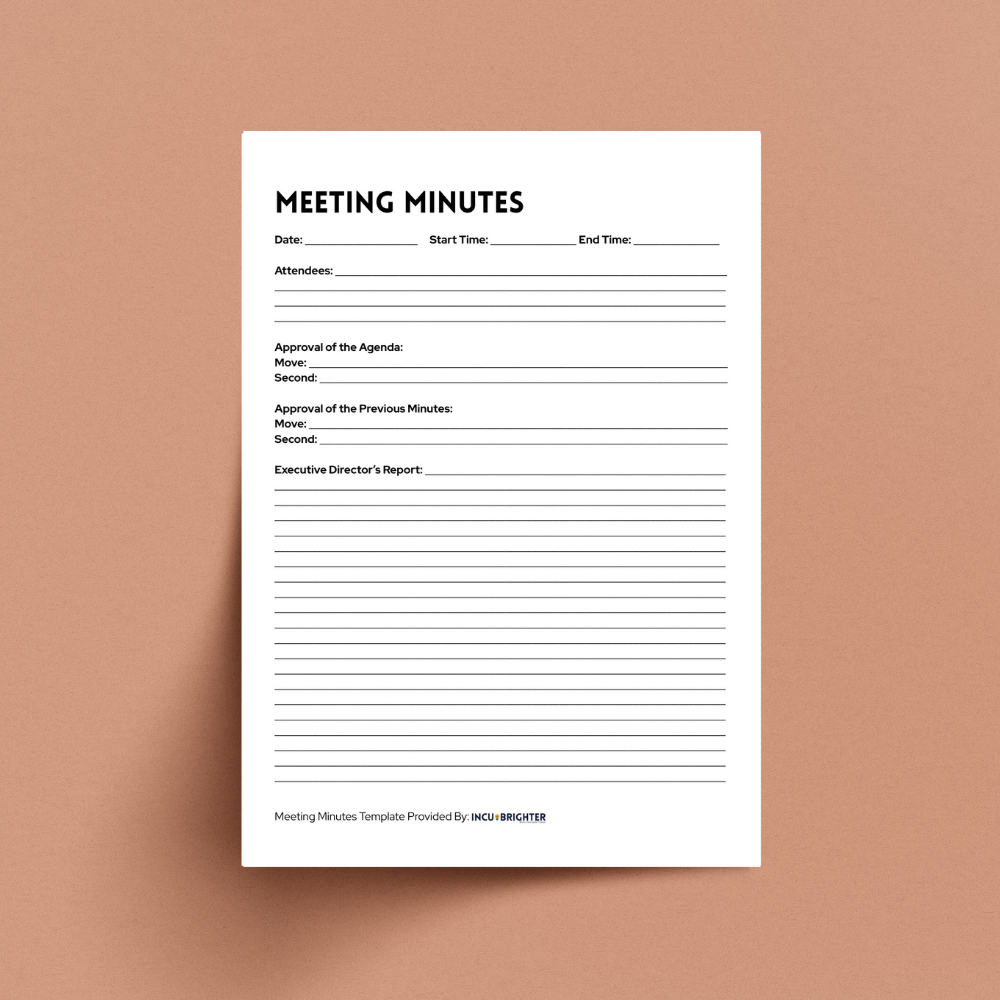
Good governance starts with good records. This printable Meeting Minutes Template gives your nonprofit board everything it needs to document meetings clearly, consistently, and completely — without the overwhelm.
Designed specifically for nonprofit boards, this three-page template walks you through every stage of a standard board meeting, from attendee tracking and agenda approval to finance reporting, new business, and formal motions. The built-in Additional Motions appendix means you'll never run out of space to capture the full picture of your board's decisions.
Print it, fill it in, file it. That's it.
What's included:
Attendee log
Agenda & minutes approval
Executive Director's Report
Finance Reporting
New Business
Additional Motions appendix
Motion documentation (text, mover/seconder, discussion summary, vote tally)
Call to Close
Best for: New and growing nonprofit boards looking for a simple, professional documentation system that holds up to audits, funders, and bylaws requirements.
