
Which Form 990 Does Your Nonprofit Need to File?

Every year, nonprofits across the country sit down to tackle one of their most important compliance tasks: filing the Form 990. But "the 990" isn't actually a single form — it's a family of related documents, and which one your organization needs to file depends on your size, structure, and the nature of your activities.
Getting this right matters more than you might think. Miss the right form (or miss filing altogether) and you risk penalties, public confusion, or even automatic loss of your tax-exempt status. The good news? Once you understand the landscape, it's pretty straightforward.
Here's a plain-English breakdown of each version and who it's for.
First, a Quick Note on What the 990 Actually Is
Despite what the name might suggest, the Form 990 is not a tax return — it's an annual information return, meaning it's a public disclosure document. Anyone can look up your organization's 990 on sites like ProPublica's Nonprofit Explorer. It's how the IRS (and the public) keeps tabs on how nonprofits are using their tax-exempt status.
Think of it as your organization's annual report card to the world. It covers your financials, your programs, your governance practices, and your executive compensation. Transparency is the whole point.
The Five Versions of the 990
1. Form 990-N — The "e-Postcard"
Who files it: Very small nonprofits with gross receipts of $50,000 or less per year.
If your organization is small and scrappy, this is your form. The 990-N is exactly what the nickname suggests — a quick electronic postcard that basically tells the IRS, "We're still here, we're still operating, and we're still small."
It asks for just eight pieces of information: your EIN, tax year, legal name, address, the name of a principal officer, your website (if you have one), confirmation that your gross receipts are $50,000 or under, and — if you're dissolving — a note about that.
That's it. No financial statements, no detailed narrative. Just a check-in.
One important caveat: Simplicity doesn't mean optional. If you don't file for three consecutive years, your organization loses its tax-exempt status automatically. No warning letter, no grace period. This catches a lot of small nonprofits off guard.
2. Form 990-EZ — The Middle Path
Who files it: Nonprofits with gross receipts under $200,000 and total assets under $500,000.
The 990-EZ is a shortened version of the full 990. It's four pages instead of twelve, and it still requires you to report on your finances, programs, and governance — just with less granular detail than the full form.
If your organization has grown beyond the 990-N threshold but isn't yet at the scale of a large institution, this is your form. Many community nonprofits, small advocacy organizations, and grassroots groups land here.
You can always voluntarily file the full Form 990 even if you qualify for the EZ — and some funders or state agencies may specifically request the full form.
3. Form 990 — The Full Return
Who files it: Nonprofits with gross receipts of $200,000 or more, or total assets of $500,000 or more.
This is the full monty. The complete Form 990 is a detailed, multi-part document that covers everything: your mission, your programs, your financials (income, expenses, net assets), your governance policies, your board members, and the compensation of your top officers and employees.
It's not a quick form to fill out, but it's also your most powerful transparency tool. A well-prepared 990 tells a compelling story about your organization's impact, financial health, and accountability. Many savvy donors and grantmakers read 990s carefully before making funding decisions.
Private foundations are generally required to file the 990-PF instead (see below), even if they would otherwise qualify for the regular 990.
4. Form 990-PF — For Private Foundations
Who files it: All private foundations, regardless of size.
Private foundations operate under a different and stricter set of IRS rules than public charities — and their annual return reflects that. The 990-PF is required for all private foundations, from small family foundations to large national grantmakers.
The 990-PF goes deeper on things that are specifically relevant to foundations: investment assets and income, grant distributions (foundations must pay out at least 5% of their investment assets each year for charitable purposes), excise taxes, and self-dealing rules.
If you're a family foundation, a corporate foundation, or any entity that receives its funding primarily from a single source rather than the general public, you're almost certainly a private foundation — and the 990-PF is your form.
5. Form 990-T — Unrelated Business Income
Who files it: Any tax-exempt organization that has $1,000 or more in gross unrelated business income (UBI) during the year.
This one is a bit different. The 990-T isn't a substitute for your regular annual return — it's filed in addition to whichever 990 form applies to your organization.
Unrelated business income is income from a trade or business that doesn't directly relate to your exempt mission. Classic examples include advertising revenue in your publications, income from renting out mailing lists, or running a gift shop that sells items unrelated to your cause.
Tax-exempt status doesn't mean all income is tax-free. If your organization earns enough UBI, you owe tax on it — currently at the corporate rate of 21% on net income. The 990-T is how you report and pay that.
Quick Reference: Which Form Do You File?
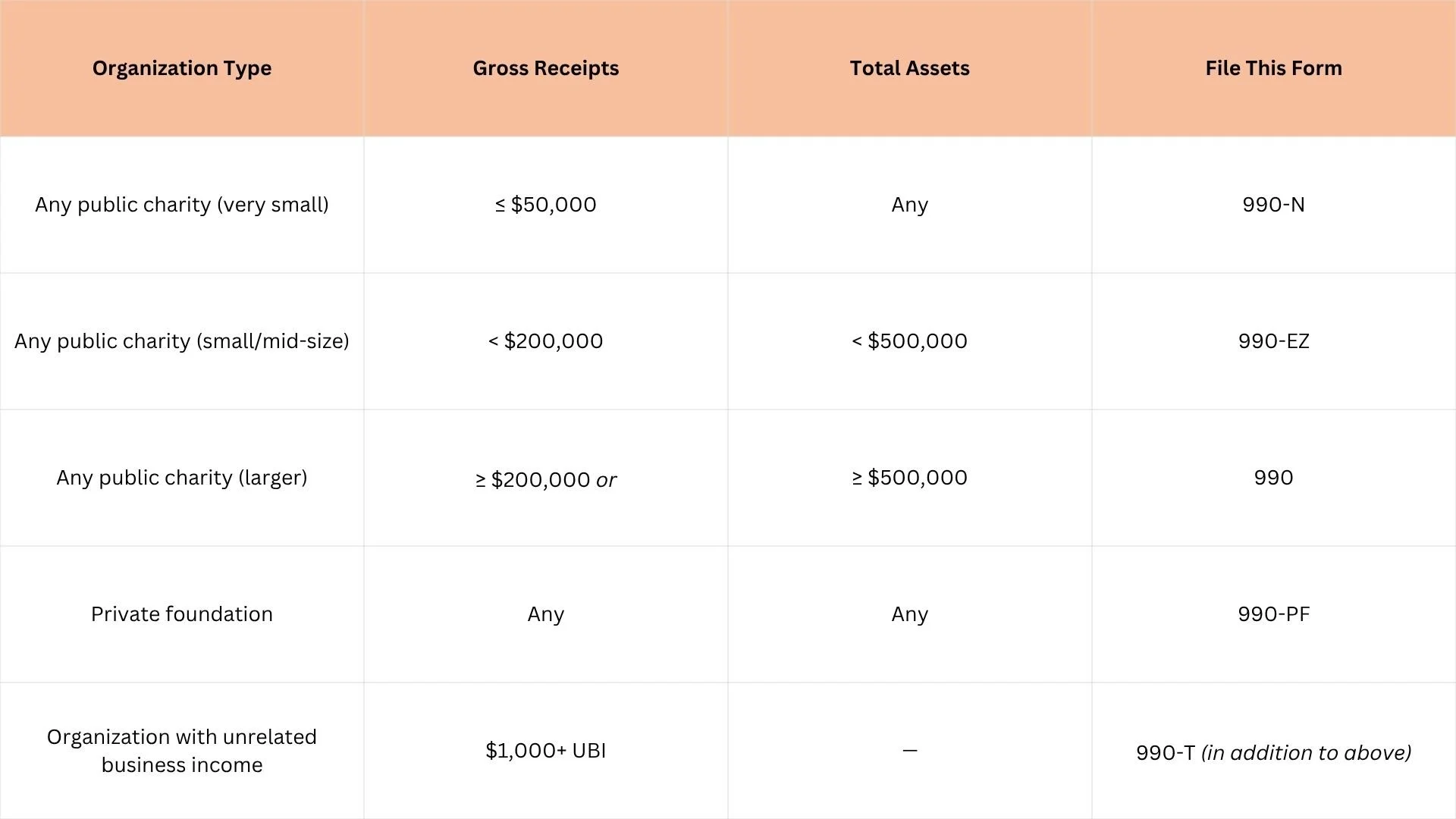
Private foundations and 509(a)(3) supporting organizations must file Form 990-PF regardless of size.
A Few Things to Keep in Mind
The three-year rule is real. If your organization fails to file the appropriate 990 form for three consecutive years, the IRS automatically revokes your tax-exempt status. Reinstatement is possible but involves paperwork, fees, and headaches you don't need. File every year, even if it feels like there's not much to report.
Your 990 is public. Whatever you file, anyone can read it. That's not a reason to dread the process — it's a reason to think of your 990 as a communications opportunity, not just a compliance chore. Strong, clear program descriptions and a clean financial picture can reassure donors and funders alike.
State requirements may differ. Many states have their own annual reporting requirements for nonprofits, which may or may not align with your federal 990 filing. Check with your state's charity registration office to make sure you're covered on both fronts.
When in doubt, talk to a professional. A nonprofit-savvy accountant or attorney can help you confirm which form applies to your situation and make sure it's filed accurately. This post is meant to give you a solid foundation — not to substitute for professional advice on your specific circumstances.
